Building a Content Operating System for an Economy Hajj and Umrah Company

Summary

  • Role: Content team lead and content marketing manager
  • Industry: Tourism (Hajj and Umrah)
  • Period: July to August 2026 (2 months)
  • Channels: Facebook and Instagram
  • Content language: Arabic

Over two months I rebuilt how a Hajj and Umrah company produced content: documented standards first, then workflow, then AI assistants. Facebook views rose 657.4% and link clicks rose 3,900% to 47,000. Paid campaigns ran during the same period, so the content operation is one factor behind those numbers rather than the only one.

The Business Context

I managed the content team for a tourism group operating several subsidiaries, with particular focus on a company selling economy Hajj and Umrah programs.

The copywriter assigned to that company had solid social media experience. She could write, and she knew the platforms.

The gap sat one level above her. The company had no documented operating system for content.

It already owned a large audience, yet the operational return from that audience stayed low. No documented content plan. No defined review process. No shared standard for deciding whether a piece was good enough to publish.

Content reviews slid easily into personal preference:

“I don’t like this wording.”

That is difficult to manage at team level.

My job was to build a system where content decisions rested on documented criteria.

The Challenge

1. A Large Audience with Limited Operational Return

The Facebook page carried 147,959 lifetime followers. Follower count on its own said nothing about whether that audience was moving toward a commercial action.

So the focus shifted to behavioral metrics:

Views → Page visits → Link clicks

A high view count can reflect media spend more than genuine interest. Link clicks sit much closer to the question that matters: is the message pushing people to the next step?

2. No Documented Content Direction

Production was not consistently tied to:

  • A specific business objective
  • A defined persona
  • A customer concern
  • A psychological angle
  • A clear action

That made every piece hard to judge past whether the copy sounded good.

3. Subjective Feedback

A copywriter cannot work efficiently when every revision traces back to a manager’s taste.

So I set one management principle:

A content comment becomes mandatory when a documented standard supports it.

That moved the conversation from:

“I don’t like this.”

to:

“This section doesn’t meet the content guideline.”

4. AI Before Standards

The team could have picked up AI tools and raised output speed immediately. Faster production does not repair an unclear process.

My build order:

Standard → Process → Responsibilities → Review → AI → Measurement

The reasoning is simple. AI multiplies whatever the writer already does. With no standard in place, it multiplies the gap.

The Solution

I built the content operation in four layers.

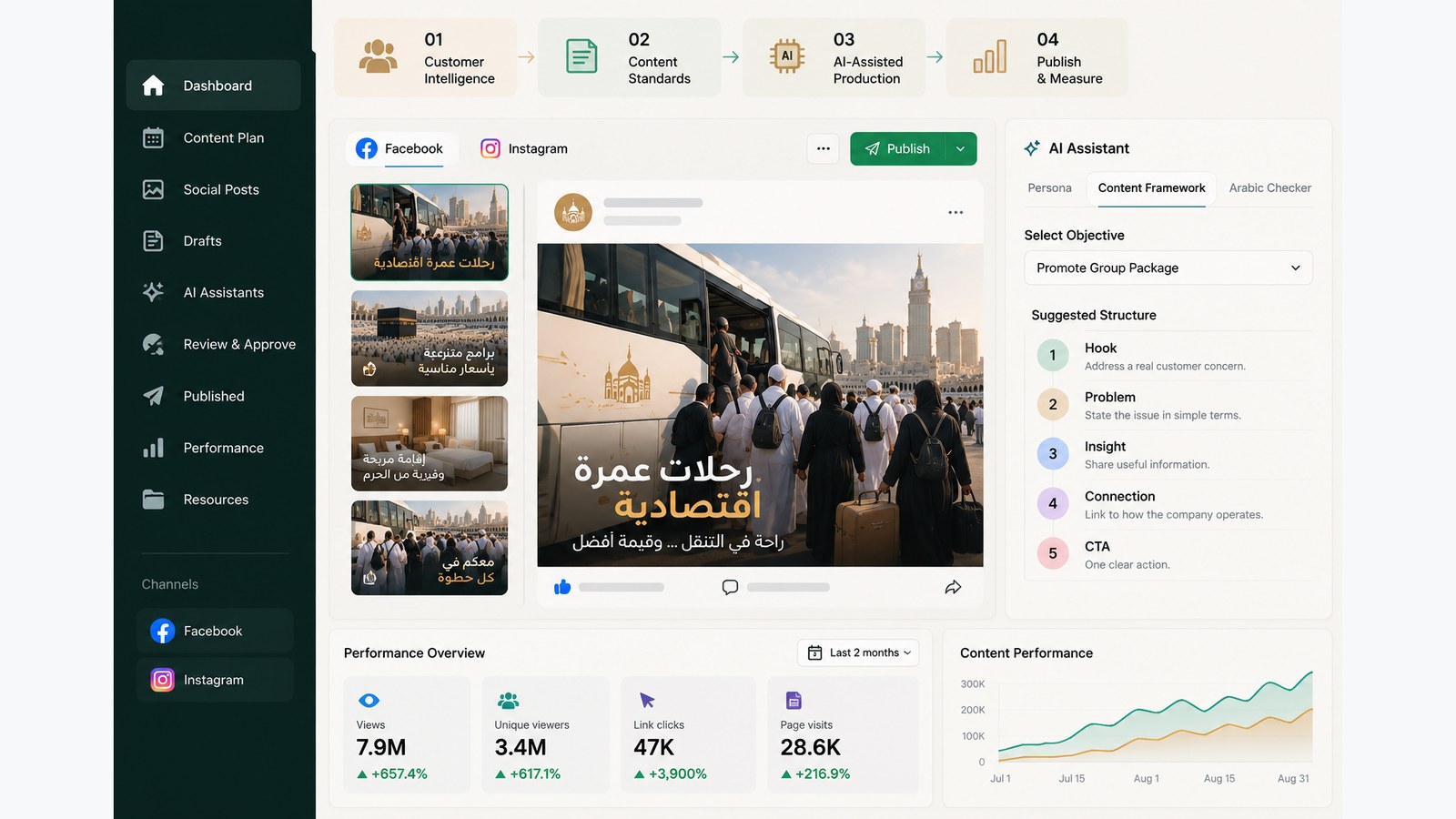
01. Documented Content Direction

The first question: what is the customer actually buying?

For an economy Hajj and Umrah service, a package description alone does not answer that. The customer wants confidence about practical details:

  • Cost
  • Accommodation
  • Distances
  • Schedule
  • Included services
  • Communication
  • What to expect during the trip

From there I set a consistent structure for social content:

Block Function
Hook Open on a real customer concern
Problem State the issue in plain terms
Insight Give the audience information they can use
Connection Link that information to how the company operates
CTA One clear action

02. Content Quality Checklist

Every piece faced documented criteria before publication:

  • Does it contain information that reflects real industry knowledge?
  • Does it stay clear of generic tourism language?
  • Is the claim backed by a number, a distance, a timeframe, or another verifiable detail where appropriate?
  • Is the language right for the audience?
  • Is the CTA clear?
  • Does it serve the objective written in the brief?

A “no” sent the piece back for revision.

Management impact: review moved from personal preference to an agreed standard. The writer gained a clearer decision framework, and I gained a consistent basis for approval.

03. Written Content Operations

I defined the copywriter’s responsibilities:

  • Monthly content planning
  • Submitting the plan for approval
  • Social media posts
  • Ad copy
  • Video scripts

Final approval stayed with me.

I introduced a six-stage workflow:

Brief → Production → Language review → Strategic review → Publishing → Measurement

No writing started without a brief covering objective, persona, psychological angle, core message, and desired action.

Revision policy: two rounds per piece. A draft that ignored the brief or leaned on generic wording was rejected before it entered the revision cycle.

I also ran an early-review step: the first piece in a batch was reviewed before the rest were written. A wrong direction got corrected once instead of repeating across the whole batch. That cut the cost of errors across the team.

04. Language Standards

Trust carries extra weight when the subject is Hajj and Umrah.

I set language rules covering generic claims, unsupported promises, Arabic grammar, translated sentence structures, tone, and factual accuracy.

The test was simple:

If the statement can be supported, use it. If it is vague or exaggerated, cut it.

Instead of claims such as “the best service,” content carried information the customer could assess for himself: prices, distances, schedules, accommodation, included services, and contact details.

AI Integration

With the standards in place, I added customized AI assistants to the workflow.

  • Persona assistant. Surfaces customer concerns, buying motivations, objections, questions, and content angles.
  • Content framework assistant. Selects the writing structure that fits the objective of each piece.
  • Arabic content checker. Runs drafts against the project’s language rules before they reach my strategic review.

I used them to catch recurring issues at the draft stage, so my review time went to strategy instead of the same corrections every week.

Results

July and August 2026 recorded strong growth across Facebook and Instagram against the previous reporting period. The performance report attributes part of that growth to paid campaigns and intensive marketing activity.
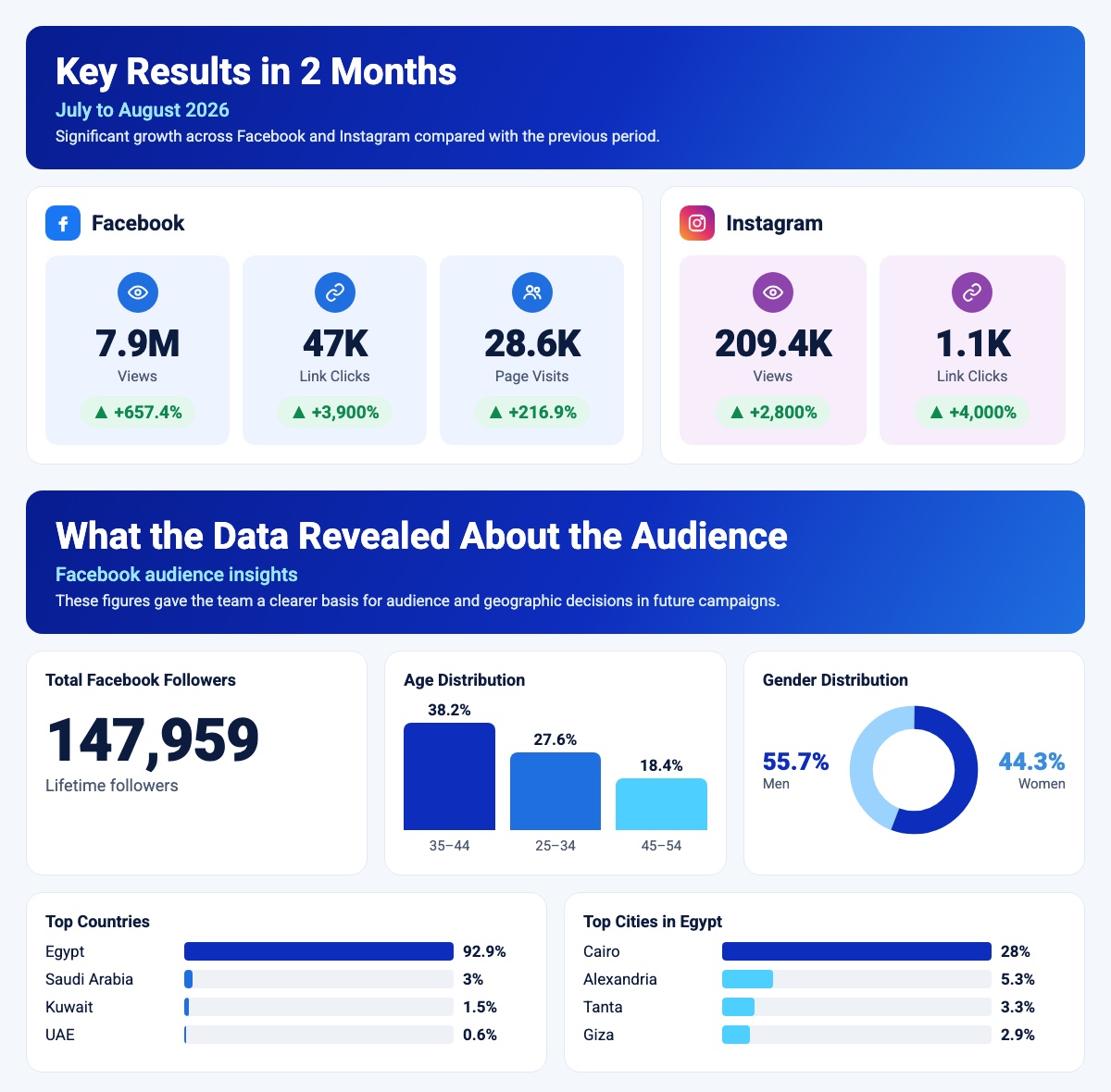
Key results in 2 months and Facebook audience insights

Facebook Performance

Metric Result Change
Views 7.9M +657.4%
Unique viewers 3.4M +617.1%
Link clicks 47K +3,900%
Page visits 28.6K +216.9%
New followers 563 +116.5%
Content interactions 12.3K -40.7%

One metric moved down: content interactions fell 40.7%.

That distinction matters. Reach and link activity climbed sharply while interactions dropped, so the data does not support a claim that every aspect of content performance improved.

Instagram Performance

Metric Result Change
Views 209.4K +2,800%
Reach 87.3K +2,100%
Link clicks 1.1K +4,000%
Profile visits 462 +192.4%
New followers 60 +160.9%

The Strongest Commercial Signal

Views measure exposure. Link clicks measure intent.

The figure I read first in this report:

47,000 Facebook link clicks

The performance report treats the 47K Facebook link clicks, alongside 1.1K on Instagram, as a strong indicator of audience interest in Hajj, Umrah, and tourism services. It recommends improving the post-click experience through a landing page or WhatsApp response automation to convert that activity into sales.

The reading is straightforward:

Content generated a large volume of traffic and action.

The next commercial opportunity sat in what happened after the click.

What the Data Showed about the Audience

Across the page’s 147,959 lifetime followers, the largest age group was 35-44, followed by 25-34, then 45-54.

Gender split: 55.7% men, 44.3% women.

Country Share
Egypt 92.9%
Saudi Arabia 3%
Kuwait 1.5%
UAE 0.6%

Inside Egypt: Cairo 28%, Alexandria 5.3%, Tanta 3.3%, Giza 2.9%.

Those figures gave the team a firmer basis for audience and geographic decisions in later campaigns.

Which Content Performed Best

The report shows that Hajj, Umrah, and travel posts carrying direct contact numbers ranked among the strongest performers.

Post Views
Direct hotline contact post 10,999
Contact capture post (name and phone) 8,556
2027 Hajj / 1448H post 6,688
Umrah 1448H post 5,437
Contact capture post (name and phone) 5,406

The two contact capture entries are separate posts using the same format.

The signal for the team was clear:

Messages tied to a direct communication action pulled substantial attention and response.

My Role

My responsibility covered more than copy review.

  • Content team management. Ran the copywriter’s workflow, responsibilities, output, and review cycle.
  • Content direction. Defined audience concerns, messaging angles, content structure, and editorial standards.
  • SOP development. Wrote the operating procedures governing briefs, production, reviews, publishing, and measurement.
  • Strategic content review. Reviewed content against business objectives instead of personal writing preference.
  • AI workflow design. Placed customized AI assistants at specific stages of the content process.
  • Performance analysis. Read Facebook and Instagram data and fed performance signals back into content and campaign decisions.

The Management Lesson

What changed in this project shows up in how the team worked, more than in how much it published.

Before:

Writer → Content → Review → Publish

After:

Brief → Persona → Content direction → Production → Language review → Strategic review → Publishing → Measurement

Every stage carries a purpose, an owner, and a review criterion.

The copywriter already had social media experience. My job was to give that experience a structured operating environment, then introduce AI once the standards held.

Two-Month Recap

Channel Metric Result Change
Facebook Views 7.9M +657.4%
Facebook Link clicks 47K +3,900%
Facebook Page visits 28.6K +216.9%
Instagram Views 209.4K +2,800%
Instagram Link clicks 1.1K +4,000%

Read these figures alongside the campaign context: the reporting period included paid advertising and intensive marketing activity, so I would not attribute the full increase to content management alone.

What I owned was the content operation: the standards, the workflow, team management, the review system, the AI workflow, and the use of performance data to drive decisions.

That is what turned the role from content supervision into content team management.