Building a Candidate Pipeline Tracker Updated by One Line of Text

Summary

A hiring pipeline that went from scattered chats to one live board, updated by a single line of text.

  • Time saved: At least 1 hour a day, about 30 hours a month
  • Setup avoided: 2 to 3 hours of spreadsheet building
  • Candidates tracked: 30+
  • Sourcing workbook: 141 public profiles from AI research rounds
  • Built with: Claude, in one working session
  • Data entry: One line of Egyptian Arabic, or a LinkedIn link
The Challenge

I was hiring for a freelance, results-based role, and my candidates were spread across four places.

  • Scattered records: 30+ candidates sat across LinkedIn messages, WhatsApp, and memory.
  • No clear status: I couldn’t tell at a glance who was waiting on whom.
  • Slipping follow-ups: Replies went unanswered for days.
  • Manual tracking: A spreadsheet would have meant 2 to 3 hours of setup, plus daily manual updates.

I needed one live view of every candidate, kept up to date without manual data entry.

What I Built

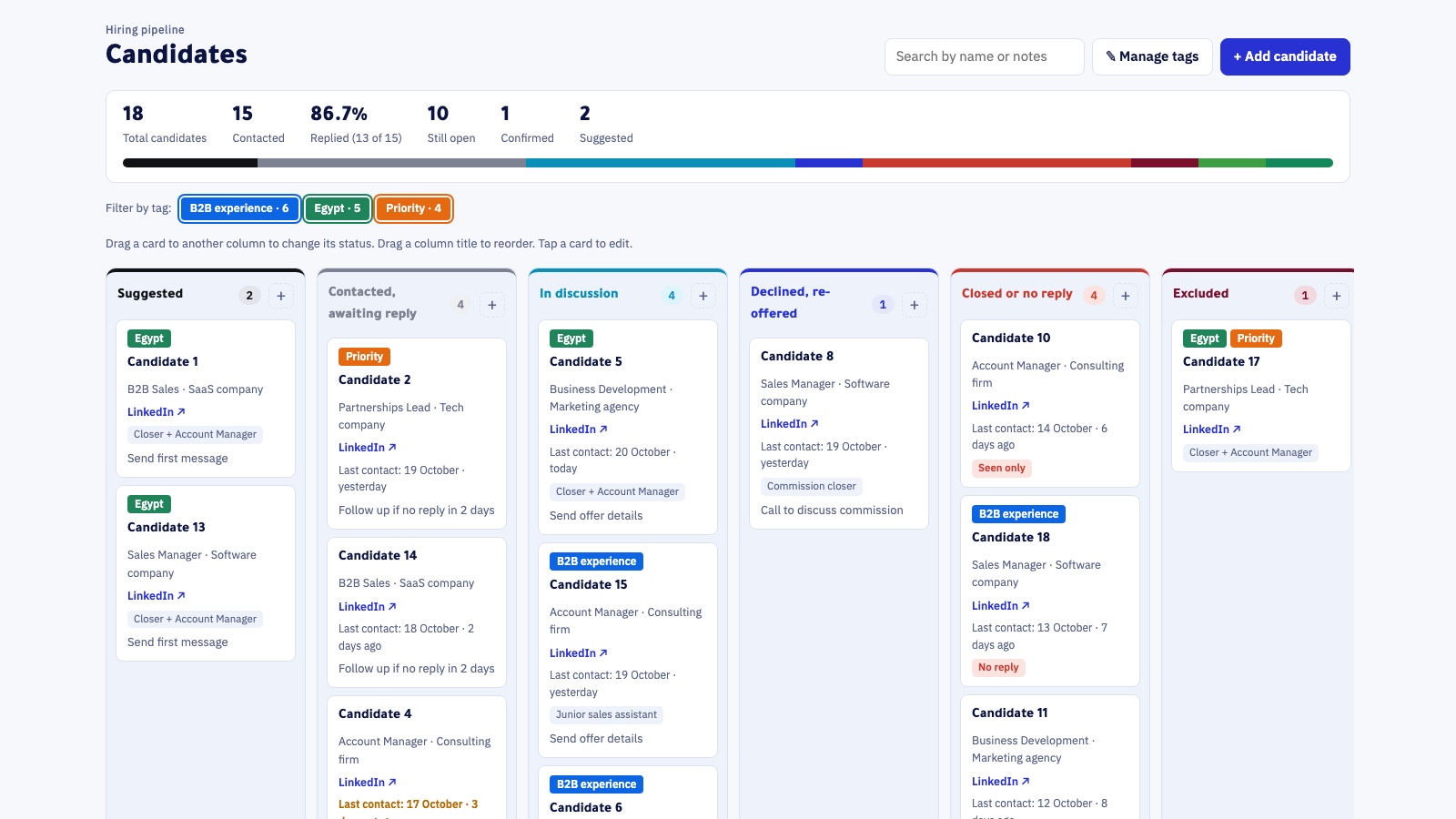
A private web app with a drag-and-drop board, built with Claude in one working session.

Feature What it does
Status board Five columns. Candidates move between stages by drag and drop.
Candidate cards Each card shows the source, current status, proposed working arrangement, last contact date, and next step.
Summary strip Calculates response rate, contact rate, acceptances, and rejections automatically.
Filters and search Find any candidate in seconds.
48-hour flag Any open candidate with no contact for more than 48 hours turns orange.

The AI Behind It

Claude wrote the app through vibe coding and now works as its data-entry agent.

  • Smart profile extraction: I paste a candidate’s LinkedIn link, and Claude pulls their details into a new card in one step.
  • Plain-language updates: I type one line in Egyptian Arabic, such as “add Ahmed, contacted him today, waiting for his reply,” and Claude writes the record into the database.
  • Automatic contact tracking: The app logs the last contact date for each candidate, so I can see who’s waiting at a glance.
  • AI sourcing: Before the board existed, AI research rounds across job boards, freelance platforms, and LinkedIn produced a sourcing workbook of 141 public profiles.

Results

The tracker saves me at least 1 hour a day, about 30 hours a month.

  • No manual data entry: A link or a single line replaces typing records by hand.
  • No spreadsheet build: I skipped 2 to 3 hours of setup work.
  • Live conversion rates: Response, contact, acceptance, and rejection rates update on their own.
  • No forgotten follow-ups: The orange flag shows anyone who has gone 48 hours without contact.
  • Built for volume: 30+ candidates on one board, each updated with a single line.